
Why characters remain one of the most effective brand assets ever created.
From the Michelin Man to the Duracell Bunny, discover how characters help brands become more distinctive, memorable and engaging, and why research continues to show their effectiveness across industries and audiences.
Recognition and distinctiveness.
Characters function as distinctive assets, shorthand signals that allow audiences to identify a brand instantly, across any context and any channel. Unlike logos or colour palettes, they can carry personality, tell stories and build emotional attachment over time.
They are not decorative. They are strategic assets that compound in value the more they appear. Every consistent use adds to a growing store of brand equity.
Brands are built from two kinds of assets.
Recognition assets such as
logos, colours, fonts etc
Emotionally connecting
assets like characters etc
There are types of assets that help people recognise you, and types of assets that help people understand who you are. Characters do both, and create emotional connection with your brand. What is a brand character?
Characters are distinctive assets that make a brand easier to remember while carrying personality, meaning and likeability. They act as strategic assets that build emotional attachment over time.
What the data says.
Market share gains
More likely to drive very large market share gains (System1).
Profit gains
More likely to generate very large profit gains (System1).
Brand difference
Of brand difference attributed to distinctive assets (Kantar).
System1's analysis found that campaigns using recurring brand-owned assets, such as characters, were 23% more likely to generate very large market share gains, and 22% more likely to deliver very large profit gains. The evidence base draws on over 25,000 advertisements, making it one of the largest of its kind.
Kantar's research adds a further dimension: up to 30% of the perceived difference between competing brands can be attributed to distinctive assets. Characters are among the most powerful of these.
The jobs characters perform.
The applications for a well-made brand character are broader than most organisations initially assume. The examples below aren't exhaustive. They're illustrative of the range of jobs a character can be asked to do, and how effectively it can do them.
A Trojan Horse for emotion
Corporate brands in B2B, tech, finance and logistics, often suffer from a sea of sameness: blue logos, jargon-heavy copy, stock photos of handshakes. A character can introduce warmth, humour and empathy into a highly rational space, without requiring the brand or its leadership to break their professional tone.
A guide through complexity
Many organisations sell invisible or highly complex services: cloud architecture, financial products, compliance frameworks. A character can act as a friendly tour guide, making dense topics more accessible without dumbing them down. Salesforce's use of Astro and its woodland characters to bring CRM software to life is a well-documented example of this at scale.
A safer messenger
When a brand needs to apologise for a service outage, explain a policy change, or deliver mandatory compliance training, having a character carry the message significantly softens the tone and reduces friction. It creates distance between the message and the brand, while keeping the communication engaging.
An asset that doesn't leave
Human spokespeople and influencers carry risk: PR issues, aging, contract renegotiations, departures. A brand-owned character is entirely controllable, carries no personal baggage, and builds pure equity over time. It belongs to the brand, not to an individual.
An internal culture builder
Characters often build recognition internally before they ever face the public. They appear on employee communications, Slack emojis, internal presentations and onboarding materials, becoming a shared reference point that unifies teams across geographies, functions and languages.
Why they work across industries.
Characters are effective not just in consumer markets. Their power extends to B2B, internal communications, employee engagement, onboarding, learning and change programmes. Anywhere that requires repeated communication to a defined audience, a well-made character can make messages more memorable, more engaging and easier to understand. Can B2B companies use brand characters?
Their effectiveness scales with consistency. The longer a character is used correctly, the more recognition it builds, and the more that recognition is worth. Should your business have a brand character?
See how we create themWhy generalist agencies struggle with character work.
Character work today sits at the intersection of brand strategy, AI image generation, motion, voice, lip sync and governance. Each of those disciplines is evolving fast, and staying genuinely current across all of them takes constant focus.
Knowing which model to use for which output, how to maintain visual and voice consistency across sessions, how to generate a full expression range that stays recognisably the same character, how to keep pace as tools that update significantly every few months: this is specialist knowledge. It compounds over time, and it only develops through focus.
Generalist agencies have a wide range of disciplines to stay current across. Character work is one of many. At Brandbornn it is the only one, and that is what allows us to build characters that work not just as a first image, but as a complete, consistent, long-term brand asset. Why use a specialist rather than a generalist agency?
Why a character could fail.
The rise of AI image generation has made it easier than ever to create a character. Which means it has never been easier to create one badly. A character that looks impressive as a rendered image but has no strategic foundation is not a brand asset. It is an illustration. And illustrations don't build equity.
Most character failures fall into two categories. Strategic and visual. Understanding both is the first step to avoiding them.
Strategic failures happen before the pen touches paper.
Visual failures happen the moment it does.
No brief behind it
The character was created because someone liked the idea, not because there was a defined job for it to do. Without a clear role, audience and purpose, the character has nowhere to go and nothing to build.
Built for trend, not brand
A large proportion of commercially available character design currently follows the same aesthetic: hyper-rendered 3D, Popmart-adjacent, collectible toy styling. These characters could belong to any brand. They carry no distinctive brand personality and build no distinctive brand equity.
Personality disconnected from the brand
A character that feels warm and playful sitting next to a brand that is authoritative and precise creates confusion, not connection. The character's personality must be an expression of the brand's personality, not a separate creative idea imposed on top of it.
No distinctive silhouette
Cover the character and show only its outline. If you can't identify it instantly, or if it looks like dozens of other characters, the design has failed its most fundamental test. Most trend-driven characters are variations on the same rounded blob.
Too complex to reproduce
A character built with hyper-detailed 3D rendering, complex textures and intricate surfaces cannot be reproduced consistently across real-world applications. It breaks at small sizes, fails in single colour and is impossible to brief a third party to use correctly. Complexity is the enemy of governance.
Colour-dependent identity
If the character is unrecognisable without its full colour palette, the design relies on colour to do work that the form should be doing. A well-made character is identifiable in black and white, at small sizes and in simplified form.
Culturally specific styling
Many of the most visually accomplished character designs in circulation are deeply rooted in East Asian IP and collectible culture. They work brilliantly in that context. They can read very differently, or not at all, to B2B or professional audiences in other markets.
The six tests a character must pass.
Anyone can generate a character with AI. What they cannot do, without the right brief, the right process and the right framework, is create one that lasts. These six tests separate a brand asset from a trend-chasing illustration. What makes a great brand character?
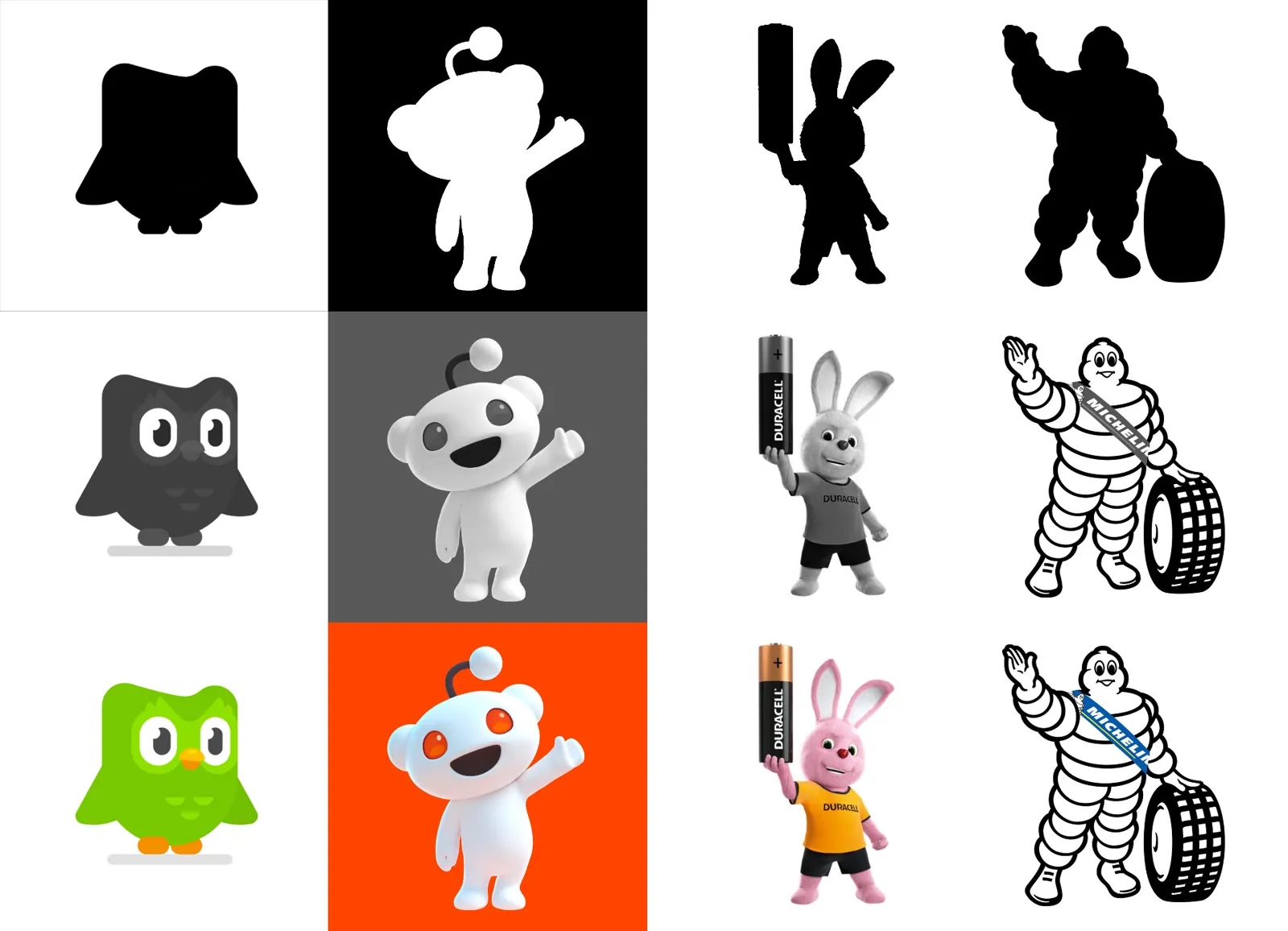
The silhouette test
Show only the character's outline, with all colour and detail removed. Is it instantly recognisable? Is it distinctive from every other character in your market? The Michelin Man, the Duracell Bunny, the Pringles man, all pass this test immediately. Most characters don't. If the silhouette could belong to anyone, the character will build nothing.
The flat reproduction test
Can the character be reproduced in a single colour? As a line drawing? In white on black and black on white? A character that only works in full-colour 3D rendering will fail across real-world applications: merchandise, presentations, small-format digital, embroidery, signage.
The colour independence test
Remove the colour entirely. Is the character still identifiable? Colour should reinforce recognition, not create it. The strongest characters are recognisable first by shape, then by colour, not the other way around.
The two-second personality test
Show the character to someone who has never seen it before. Within two seconds, ask them to describe its personality. If they can't, or if their description doesn't match the brand's - the design has failed. Curious, authoritative, playful, trustworthy. The character should communicate this before a single word is read.
The cultural portability test
Does the character read the same way across cultures, languages and professional contexts? Styling that works perfectly in one market can carry unintended meanings, or simply fail to land - in another. For organisations with international audiences, cultural portability is a hard requirement.
The likeability test
This is the test that has no equivalent in logo design. A logo needs to be recognised. A character needs to be liked, or at minimum, not actively disliked. A character that people find unsettling, irritating or alienating is worse than no character at all.
How we build characters that pass every testAI has changed who can make a character. It hasn't changed what makes one work. That still requires strategy, definition and a system, before a single image is generated.